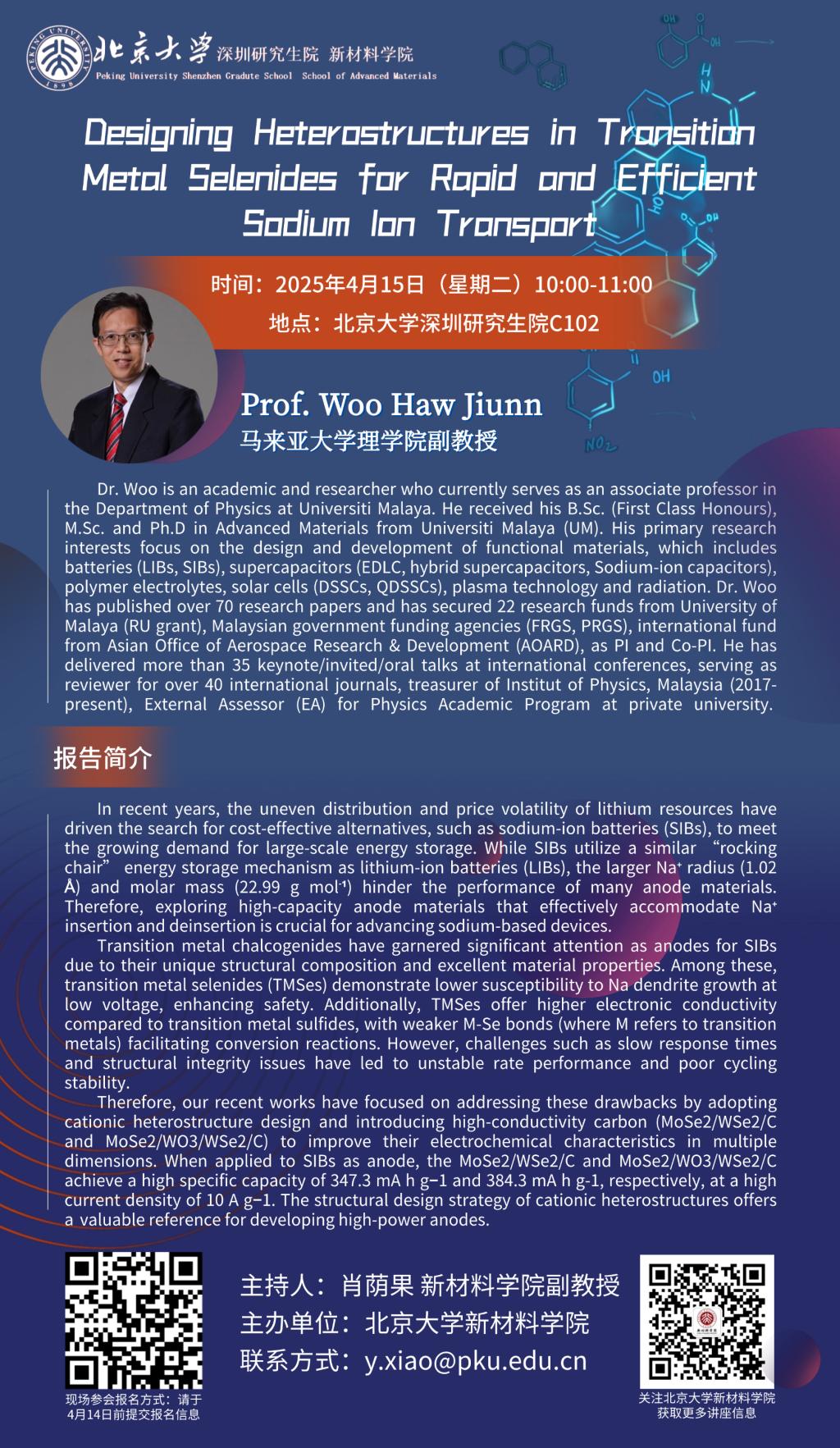
DESIGNING HETEROSTRUCTURES IN TRANSITION METAL SELENIDES FOR RAPID AND EFFICIENT SODIUM ION TRANSPORT
Woo Haw Jiunn
PhD, Associate Professor, Department of Physics, Faculty of Science, Universiti Malaya, Malaysia
Abstract
In recent years, the uneven distribution and price volatility of lithium resources have driven the search for cost-effective alternatives, such as sodium-ion batteries (SIBs), to meet the growing demand for large-scale energy storage. While SIBs utilize a similar “rocking chair” energy storage mechanism as lithium-ion batteries (LIBs), the larger Na? radius (1.02 ?) and molar mass (22.99 g mol?1) hinder the performance of many anode materials. Therefore, exploring high-capacity anode materials that effectively accommodate Na? insertion and deinsertion is crucial for advancing sodium-based devices.
Transition metal chalcogenides have garnered significant attention as anodes for SIBs due to their unique structural composition and excellent material properties. Among these, transition metal selenides (TMSes) demonstrate lower susceptibility to Na dendrite growth at low voltage, enhancing safety. Additionally, TMSes offer higher electronic conductivity compared to transition metal sulfides, with weaker M-Se bonds (where M refers to transition metals) facilitating conversion reactions. However, challenges such as slow response times and structural integrity issues have led to unstable rate performance and poor cycling stability.
Therefore, our recent works have focused on addressing these drawbacks by adopting cationic heterostructure design and introducing high-conductivity carbon (MoSe2/WSe2/C and MoSe2/WO3/WSe2/C) to improve their electrochemical characteristics in multiple dimensions. When applied to SIBs as anode, the MoSe2/WSe2/C and MoSe2/WO3/WSe2/C achieve a high specific capacity of 347.3 mA h g?1 and 384.3 mA h g-1, respectively, at a high current density of 10 A g?1. The structural design strategy of cationic heterostructures offers a valuable reference for developing high-power anodes.
Speaker's Introduction
Dr. Woo is an academic and researcher who currently serves as an associate professor in the Department of Physics at Universiti Malaya. He received his B.Sc. (First Class Honours), M.Sc. and Ph.D in Advanced Materials from Universiti Malaya (UM). His primary research interests focus on the design and development of functional materials, which includes batteries (LIBs, SIBs), supercapacitors (EDLC, hybrid supercapacitors, Sodium-ion capacitors), polymer electrolytes, solar cells (DSSCs, QDSSCs), plasma technology and radiation. Dr. Woo has published over 70 research papers and has secured 22 research funds from University of Malaya (RU grant), Malaysian government funding agencies (FRGS, PRGS), international fund from Asian Office of Aerospace Research & Development (AOARD), as PI and Co-PI. He has delivered more than 35 keynote/invited/oral talks at international conferences, serving as reviewer for over 40 international journals, treasurer of Institut of Physics, Malaysia (2017-present), External Assessor (EA) for Physics Academic Program at private university.