Organic 2D crystals as energy materials
T. Heine
School of Science, TU Dresden, Germany
Abstract
The availability of sufficient and cheap energy, arising from sustainable resources, would change the planet to the good. It is well-known that cheap energy boosts the economy, but it also tames the population explosion and thus contributes to avoid starvation and social conflicts. The recent political developments demonstrate that sustainable energy either needs sustainable political support, or, and that is my viewpoint, it simply must be cheaper than fossil alternatives.
Energy materials contribute in the conversion of energy from sustainable resources such as solar and wind energy, or of waste energy, and are thus needed to manufacture solar cells, photocatalysts, thermoelectrics and osmotic power generators. The storage of energy requires batteries and supercapacitors, whose performance heavily relies on the materials they are made of.
In this talk I will cover a range of examples of our recent research where we contributed in the development of energy materials. Most of the work is based on organic 2D crystals [1], that is those 2D polymers that exhibit high crystallinity in 2D. These ultrathin materials can be utilized as coatings or skins for electrodes, suppressing unwanted side reactions and dendrite formation [2,3]. They can be used to photocatalyze a wide range of chemical reactions, notably water splitting [4] and the formation of hydrogen peroxide [5], and they can be used of osmotic power generation [6]. The different chemical potential in 2D heterostructures can result in efficient charge separation [7].
Another materials class are metal-organic frameworks (MOFs) can covalent organic frameworks (COFs), which are particularly suitable for new battery types, such as Li-sulphur batteries, which take advantage of the capability of sulpher to form oligomers in the framework pores [8-12]. I finally present a strategy to channel exciton formation in MOFs using an external electric field [13].
References
[1] Z. Wang, M. Wang, T. Heine, X. Feng, Nat. Rev. Mater. 10 (2024) 147-166
[2] Q. Guo, W. Li, X. Li, J. Zhang, D. Sabaghi, J. Zhang, B. Zhang, D. Li, J. Du, X. Chu, S. Chung, K. Cho, N. N. Nguyen, Z. Liao, Z. Zhang, X. Zhang, G. F. Schneider, T. Heine, M. Yu, X. Feng, Nat. Comm. 15 (2024) 2139
[3] D. Sabaghi, Z. Wang, P. Bhauriyal, Q. Lu, A. Morag, D. Mikhailovia, P. Hashemi, D. Li, C. Neumann, Z. Liao, A. M. Dominic, A. S. Nia, R. Dong, E. Zschech, A. Turchanin, T. Heine, M. Yu, X. Feng, Nat. Comm. 14 (2023) 760
[4] Y. Jing, X. Zhu, S. Maier, T. Heine, Trends Chem. 4 (9) (2022) 792-806
[5] R. Liu, Y. Chen, H. Yu, M. Polozij, Y. Guo, T. C. Sum, T. Heine, D. Jiang, Nat. Catal. 7 (2024) 195-206
[6] Z. Zhang, P. Bhauriyal, H. Sahabudeen, Z. Wang, X. Liu, M. Hambsch, S. C. B. Mannsfeld, R. Dong, T. Heine, X. Feng, Nat. Comm. 13 (2022) 3935
[7] Z. Wang, S. Fu, W. Zhang, B. Liang, T.-J. Liu, M. Hambsch, J. F. P?hls, Y. Wu, J. Zhang, T. Lan, X. Li, H. Qi, M. Polozij, S. C. B. Mannsfeld, U. Kaiser, M. Bonn, R. T. Weitz, T. Heine, S. S. P. Parkin, H. I. Wang, R. Dong, X. Feng, Adv. Mater. 36 (2024) 2311454.
[8] S. Haldar, A. L. Waentig, A. R. Ramuglia, P. Bhauriyal, A. H. Khan, D. L. Pastoetter, M. A. Isaacs, A. De, E. Brunner, M. Wang, T. Heine, I. M. Weidinger, X. Feng, A. Schneemann, S. Kaskel, ACS Energy Lett. 8 (2023) 5098-5106
[9] P. Bhauriyal, T. Heine, J. Mater. Chem. A 10 (2022) 12400-12408
[10] S. Haldar, P. Bhauriyal, A. R. Ramuglia, A. H. Khan, S. De Kock, A. Hazra, V. Bon, D. L. Pastoetter, S. Kirchhoff, L. Shupletsov, A. De, M. A. Isaacs, X. Feng, M. Walter, E. Brunner, I. M. Weidinger, T. Heine, A. Schneemann, S. Kaskel, Adv. Materials 35 (2023) 2210151
[11] S. Haldar, P. Bhauriyal, A. R. Ramuglia, A. H. Khan, S. De Kock, A. Hazra, V. Bon, D. L. Pastoetter, S. Kirchhoff, L. Shupletsov, A. De, M. A. Isaacs, X. Feng, M. Walter, E. Brunner, I. M. Weidinger, T. Heine, A. Schneemann, S. Kaskel, Adv. Materials 35 (2023) 2210151
[12] S. Haldar, M. Wang, P. Bhauriyal, A. Hazra, A. H. Khan, V. Bon, Mark A. Isaacs, A. De, L. Shupletsov, T. Boenke, J. Grothe, T. Heine, E. Brunner, X. Feng, R. Dong, A. Schneemann, S. Kaskel, J. Am. Chem. Soc. 144 (2022) 9101-9112
[13] P. Singhvi, N. Vankova, T. Heine, Chem. Eur. J. 30 (2024) e202400180
Speaker's introduction
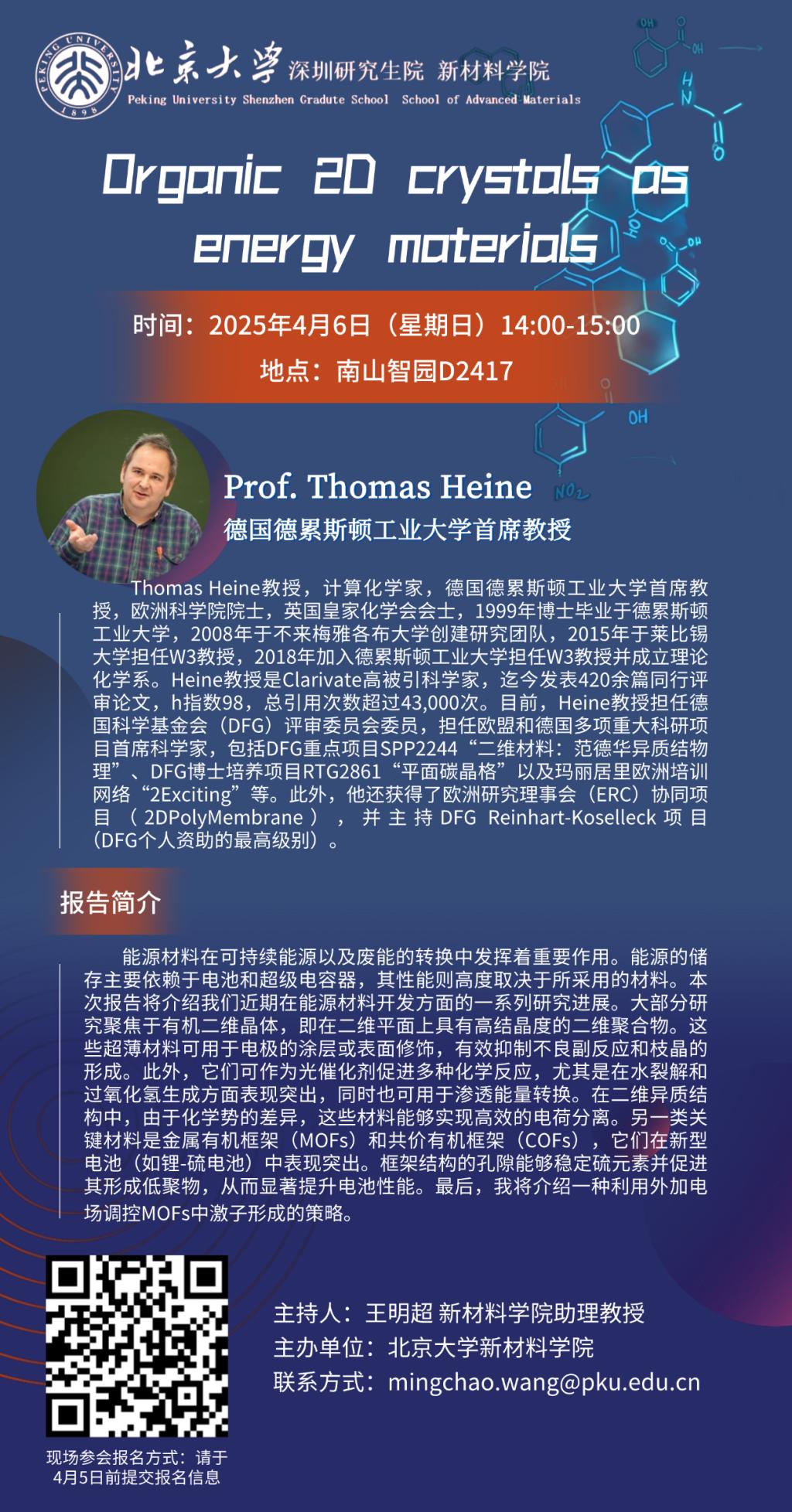
Thomas Heine, FRSC, MAE (PhD 1999, venia legendi 2006 TU Dresden) started his research group in 2008 at Jacobs University Bremen, moved in 2015 to University of Leipzig and 2018 to his current position as chair professor of theoretical chemistry at TU Dresden. He is a Clarivate Highly Cited Researcher with more than 420 peer-reviewed articles, an h-index of 98 (ISI) / 110 (Google Scholar), and more than 43000 citations. Prof. Heine is elected member of the Review Board of Deutsche Forschungsgemeinschaft (DFG). He coordinates DFG Priority Program PP 2244 “2D Materials: Physics of van der Waals [hetero]structures”, the DFG Researcher Training Group RTG 2861 “Planar Carbon Lattices”, and the Marie S. Curie European Training Network “2Exciting”. He holds a prestigious ERC Synergy Grant (2DPolyMembrane) and a DFG Reinhart-Koselleck project (top funding scheme for individuals by DFG).
講座摘要:
能源材料在可持續(xù)能源以及廢能的轉(zhuǎn)換中發(fā)揮著重要作用。能源的儲(chǔ)存主要依賴于電池和超級(jí)電容器,其性能則高度取決于所采用的材料。本次報(bào)告將介紹我們近期在能源材料開發(fā)方面的一系列研究進(jìn)展。大部分研究聚焦于有機(jī)二維晶體,即在二維平面上具有高結(jié)晶度的二維聚合物。這些超薄材料可用于電極的涂層或表面修飾,有效抑制不良副反應(yīng)和枝晶的形成。此外,它們可作為光催化劑促進(jìn)多種化學(xué)反應(yīng),尤其是在水裂解和過氧化氫生成方面表現(xiàn)突出,同時(shí)也可用于滲透能量轉(zhuǎn)換。在二維異質(zhì)結(jié)構(gòu)中,由于化學(xué)勢(shì)的差異,這些材料能夠?qū)崿F(xiàn)高效的電荷分離。另一類關(guān)鍵材料是金屬有機(jī)框架(MOFs)和共價(jià)有機(jī)框架(COFs),它們?cè)谛滦碗姵兀ㄈ玟?/span>-硫電池)中表現(xiàn)突出。框架結(jié)構(gòu)的孔隙能夠穩(wěn)定硫元素并促進(jìn)其形成低聚物,從而顯著提升電池性能。最后,我將介紹一種利用外加電場調(diào)控MOFs中激子形成的策略。
主講人簡介:
Thomas Heine,計(jì)算化學(xué)家,德國德累斯頓工業(yè)大學(xué)首席教授,歐洲科學(xué)院院士,英國皇家化學(xué)會(huì)會(huì)士,1999年博士畢業(yè)于德累斯頓工業(yè)大學(xué),2008年于不來梅雅各布大學(xué)創(chuàng)建研究團(tuán)隊(duì),2015年于萊比錫大學(xué)擔(dān)任W3教授,2018年加入德累斯頓工業(yè)大學(xué)擔(dān)任W3教授并成立理論化學(xué)系。Heine教授是Clarivate高被引科學(xué)家,迄今發(fā)表420余篇同行評(píng)審論文,h指數(shù)98,總引用次數(shù)超過43,000次。目前,Heine教授擔(dān)任德國科學(xué)基金會(huì)(DFG)評(píng)審委員會(huì)委員,擔(dān)任歐盟和德國多項(xiàng)重大科研項(xiàng)目首席科學(xué)家,包括DFG重點(diǎn)項(xiàng)目SPP2244“二維材料:范德華異質(zhì)結(jié)物理”、DFG博士培養(yǎng)項(xiàng)目RTG2861“平面碳晶格”以及瑪麗居里歐洲培訓(xùn)網(wǎng)絡(luò)“2Exciting”等。此外,他還獲得了歐洲研究理事會(huì)(ERC)協(xié)同項(xiàng)目(2DPolyMembrane),并主持DFG Reinhart-Koselleck項(xiàng)目(DFG個(gè)人資助的最高級(jí)別)。